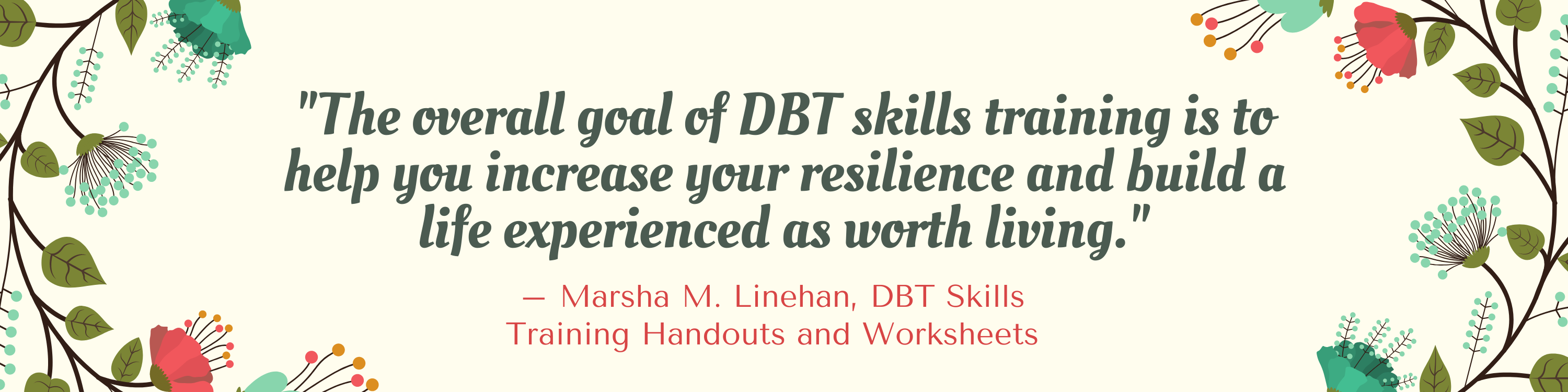
Dialectical behavior therapy (DBT) is a cognitive-behavioral psychotherapy that was developed in the late 80’s by Dr. Marsha M. Linehan. DBT is an evidence-based psychotherapy, and it was originally developed to treat people with borderline personality disorder and people who were highly suicidal.
DBT tries to strike a balance between acceptance and change, and it encourages living life in the gray area instead of viewing everything so black-and-white. It’s about learning to walk the middle path, and it really emphasizes the value of mindfulness – existing and experiencing the current moment.
Dr. Marsha Linehan: “Why Learn DBT Skills?”
Structure of DBT Sessions
From my experiences in DBT programs, there are two types of DBT weekly therapy: individual therapy and group therapy.
Group therapy focuses on skills training. There’s pretty much a DBT skill for everything, so group is meant to cover a lot of content in a way that often feels more like a classroom and less like therapy. DBT is structured in four modules – mindfulness, interpersonal effectiveness, distress tolerance, and emotion regulation. The length of a DBT group program depends on how in-depth the program goes.
In individual therapy, your therapist will help you to process your emotions, problem solve, or help you fine-tune your skills. There will often be a phone coaching component as well.
Dr. Marsha Linehan: “The 4 Skill Modules in DBT”
Self-Study Recommendations
I highly recommend working through the skills while you’re seeing a mental health professional. A mental health professional who is trained in DBT will be the best equipped to support you. I’ve done my best to put together a resource that can help anybody to learn these skills, but this is still a peer-created resource and has its limitations.
To mirror the structure of a formal DBT program, I suggest focusing on 1-2 skills/lessons each week as you’re self-studying. This will allow you to give each skill the focus and practice that it needs.
Dr. Marsha Linehan: “Are DBT Skills for Everybody?”
Tips for Beginners
- In a lot of ways, learning DBT skills is kinda like learning a new language. It’s okay to get tripped up and ask questions, but as you work with it more, you start to pick up on the vocabulary.
- Each DBT skill has a variety of ways that you can practice it, and there are usually multiple skills that can meet the same goal. So if one skill doesn’t work for you, there are tons of other things you can try. Usually, something will work; it just takes some practice, some willingness to try something new, and some trial-and-error.
- I highly recommend finding online communities geared toward DBT, such as Facebook groups. These are a great place to ask for skill suggestions or feedback about anything you’re struggling with, especially if you’re self-studying.
 Cassia